Hosting & Gifts · Cold storage
Make Room in the Fridge Before Buying Party Drinks
Bottle counts and shelf space are different questions. Give the first round a place before buying the reserve.
Hypothetical geometry, before access and appliance constraints
- 01Available patch12 × 10 in
Assumed clear rectangle with suitable height
- 02Bottle grid12 positions
Assumed 3 × 3 inch bottle footprints
- 03Pitcher strip6 positions
Reserve a six-inch-wide strip, then count the remaining grid
Not a safe load limit or usable capacity guarantee; follow your appliance instructions and keep airflow clear
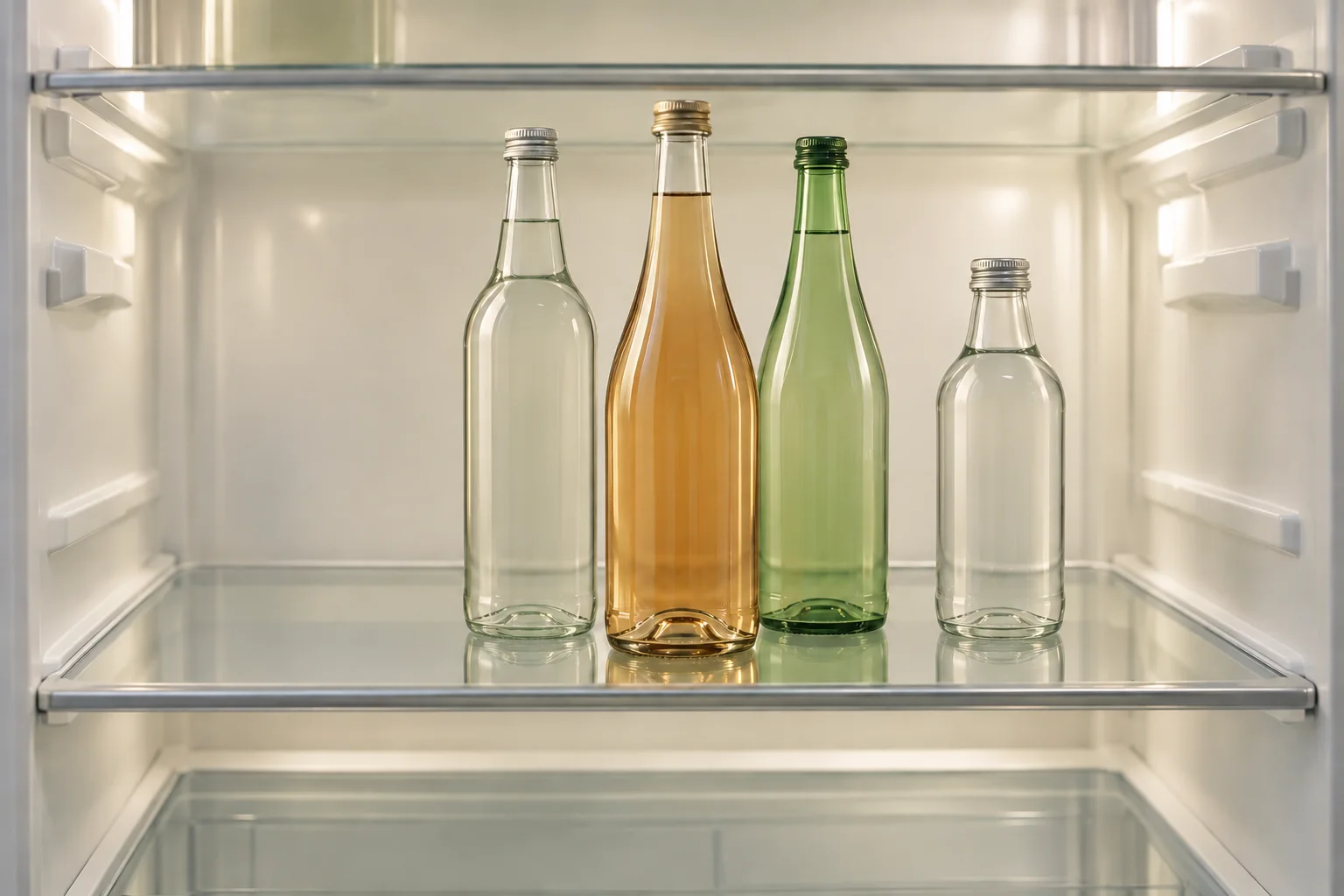
The drinks fit in the shopping bag. That does not mean they fit beside dinner. A refrigerator plan has to accommodate bottle height, the space occupied by containers and the food already committed to the same shelves—not just a total number of liters.
Before buying extra bottles for a gathering, give the first round a place to stand. Then decide where the unopened reserve belongs according to its own storage instructions. That small distinction can change which formats are practical without turning your kitchen into a catering operation.
Count containers, then look at the shelf
Two packages containing the same amount of drink can occupy different shapes. A tall bottle needs vertical clearance; a short can may fit where that bottle does not. A pitcher also needs space around its handle and lid, and enough room to lift it out. Its liquid capacity alone does not describe its footprint.
Take the dimensions from a manufacturer when available, or measure the actual container you already own. Include closures and handles rather than measuring only the body. Check the refrigerator's own instructions before adjusting shelves or loading them heavily. There is no universal bottle arrangement that applies to every appliance.
Whirlpool's organizing guidance advises against overfilling, and its care guidance calls for space for airflow and sealed liquid containers. Treat that as a reason not to pack every visible gap. The arithmetic below is a planning illustration, not permission to block vents or exceed a shelf's loading instructions.
A simple footprint example
Imagine a clear rectangular patch of shelf that is 12 inches wide and 10 inches deep, with suitable height above it. Suppose the drink bottles you actually measured need 3 by 3 inches each when kept upright. In a simple rectangular arrangement, four positions fit across and three fit in depth: twelve nominal positions.
Now add a pitcher whose footprint, including its handle, is 6 by 4 inches. In this invented layout, assigning it a full-depth strip six inches wide leaves a six-inch-wide strip for bottles. That strip takes two bottles across and three deep: six nominal positions. It is an intentionally conservative layout, not the mathematically densest packing.
| Planning object | Assumed dimensions | What the example establishes |
|---|---|---|
| Available shelf patch | 12 × 10 inches | A defined rectangle, not the appliance's full capacity |
| Upright bottle footprint | 3 × 3 inches | Twelve nominal grid positions without the pitcher |
| Pitcher in a reserved strip | 6 × 4 inches, handle included | Six nominal bottle positions in the remaining strip |
Those are positions in the chosen rectangular layout, not the maximum packing of every bottle shape. Height, vents, shelf supports, access and the appliance's instructions may reduce what is usable. The useful discovery is simpler: one pitcher can take the space you had mentally assigned to several bottles. Put its handle and removal path on the sketch before filling the shopping basket.
Give the first round priority
Write a short list with three columns: container, where it must be stored, and when you expect to use it. Mark the items needed for the first round. Put foods and any drinks that require refrigeration ahead of optional extras that can remain elsewhere under their own unopened-storage directions.
Do not assume every non-alcoholic bottle belongs on a shelf outside the fridge. Ghia, for instance, gives different guidance for its Original Apéritif before and after opening. Another product may require refrigeration throughout. Check each exact package rather than assigning a rule to the whole drinks category.
Next, remove items that your menu does not use. Chilling three alternatives “just in case” may displace the mixer needed by the recipe everyone can actually order. Water also deserves a deliberate place in the plan; do not let a collection of specialty bottles consume all the space by default.
Reserve stock is not a cooling schedule
If a sealed product may be stored outside the refrigerator, that gives you somewhere to keep reserve stock. It does not tell you how quickly it will reach the serving condition you want later. This guide does not assign a number of minutes to chilling a room-temperature bottle, or promise that an ice bucket performs like a refrigerator.
Keep any cooling arrangement within the instructions for the drink, appliance and container involved. If the available space cannot support the service you planned, reduce the number of simultaneous options or choose a different documented format. That is a better decision than promising guests a cold drink from a bottle you cannot accommodate.
For opened components, keep the original identity and handling information available. A decanted clear liquid is harder to identify, and transferring it does not restart an after-opening clock. Nor should a refrigerator plan be mistaken for a shelf-life assessment of a finished mixture.
Let space change the menu early
The useful moment to make this decision is before checkout, not while dinner occupies the worktop. Compare one ready-to-drink option with one made-to-order recipe and water, then ask whether all the needed containers have a workable home. A smaller selection can make the occasion easier to serve without making it less welcoming.
Once the space is settled, separate the preparation you can do early from the final mixing. The fridge plan answers where the components go. The serving plan answers when they become a drink. Keeping those questions separate makes both lists shorter and more reliable.
- Whirlpool — Refrigerator organizing and interior-care guidance
- Ghia — Original Apéritif and storage FAQ