Hosting & Gifts · Bringing drinks
What to Bring to a Dinner Party When You’re Not Drinking
Choose a personal supply, shared bottle, or gift, then bring the missing pieces without assigning your host a new job.
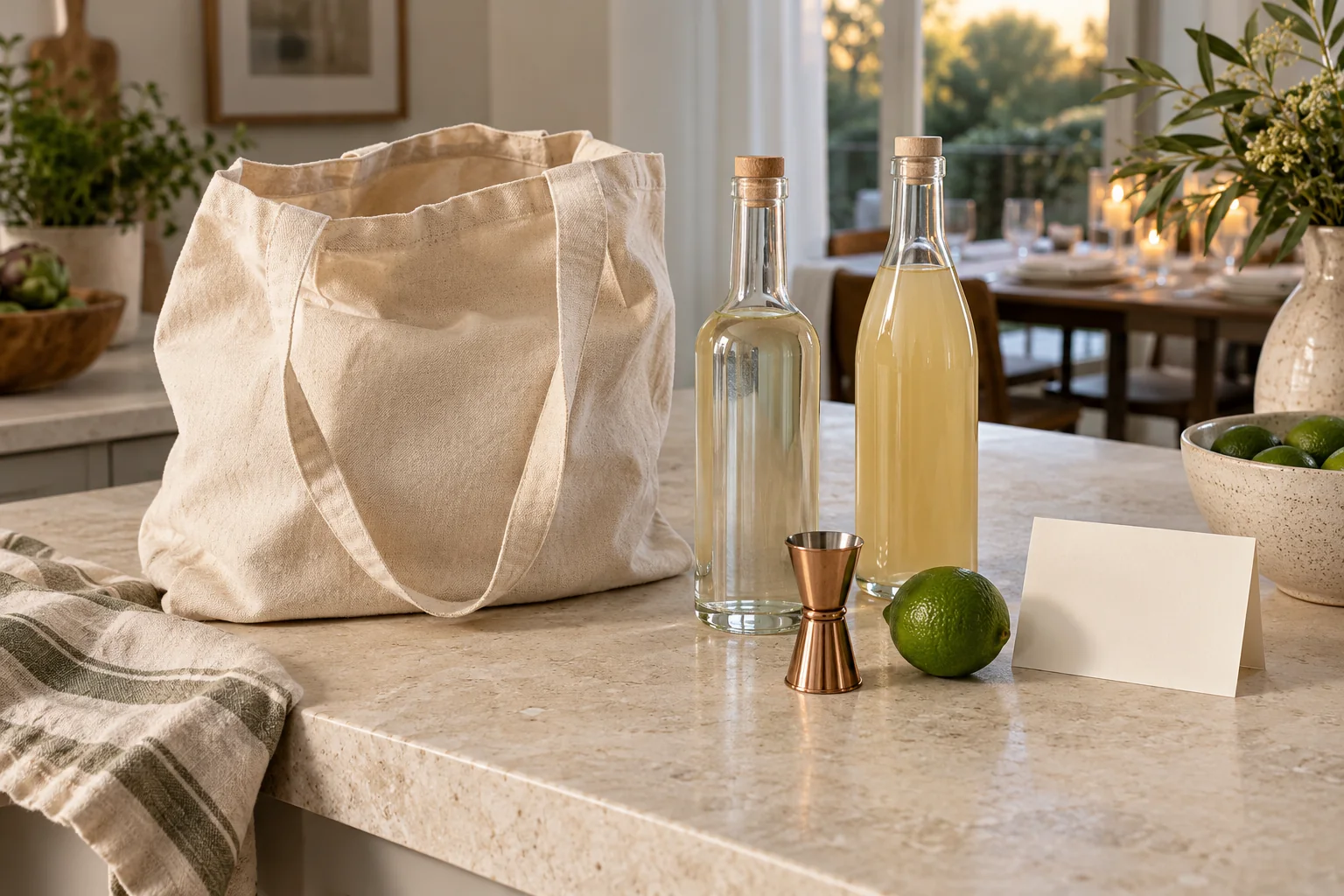
The most useful bottle to bring is one your host can serve without stopping dinner to solve it. That might be a ready drink you enjoy, a bottle for a shared toast, or the ingredients for a measured mixed drink you have agreed to assemble yourself. It does not have to be a gift set, and it does not need to explain why you are not drinking.
A short message does more work than an elaborate shopping trip: “I'll bring my drinks. Would you like some for the table too, and is there room to chill them?” The answers tell you the quantity and format. They also prevent a familiar mismatch: arriving with a concentrate that everyone assumes is ready to pour.
Decide whether it is yours, shared, or a gift
Those are three different contributions. For your own drink, bring the amount you expect to use and any ingredient the host has not offered. For a shared option, agree on the number of pours you are making available. For a gift, let the host keep it unopened rather than turning it into an obligation to serve it immediately.
Do not count a gift bottle as your personal supply unless that has been agreed. Equally, a host's wine glasses do not mean the host has ice, lime, tonic, or a measuring tool waiting for a new recipe. Make the missing pieces explicit before leaving home.
A ready format is often the least demanding choice when you do not know the kitchen. Check whether each unit is intended to be consumed as supplied; a miniature mixer or spirit alternative is not a complete drink just because it is portable. Keep its original packaging so the ingredient and alcohol information travels with it.
If you bring a base, bring the rest of its job
Ritual's G&T illustrates the difference between a thoughtful contribution and a bottle that creates work. Its recipe is 2 fl oz Gin Alternative and 4 fl oz tonic, with ice and lime, built in a highball. For two individual glasses, the measured liquid requirement is 4 fl oz base and 8 fl oz tonic. That is roughly 118 ml and 237 ml; ice and garnish are additional.
The base bottle may be large enough for many more pours, but your host still needs the mixer for the two you intend to make. Agree whether to bring ice or use theirs, and bring a measure if one has not been confirmed. Do not turn up expecting a full bar because a recipe has only two measured liquids.
If you choose this route, keep the G&T method with the ingredients so a helper has the same measures and finishing steps. It is a small addition to the bag, not another task for your host to research.
Leave purchased drinks in their suitable original containers so guests can check the labels. If you bring a separately prepared component, label its contents and follow its own storage needs. The commercial bottle's storage directions do not establish a shelf life for a homemade mixture.
A shared bottle needs a pour count
For a toast, ask how many people actually want the option. At an editorially chosen 3 fl oz pour, six people need 18 fl oz, about 532 ml. Freixenet Mionetto USA documents a 750 ml Alcohol Removed Sparkling White bottle, which nominally covers that example before serving losses. It is one possible format, not a taste recommendation or a promise about local stock.
If twelve people want that same pour, the plan becomes 36 fl oz, about 1.06 liters: one 750 ml bottle no longer covers it. That small calculation is worth doing before buying a larger gift package. The chosen pour belongs to the plan; do not represent it as the producer's required serving.
Make transport part of the contribution
Ask about cold space before assuming a bottle can go straight into the refrigerator. Follow the exact product's instructions for unopened and opened storage. Something that benefits from being chilled for serving is not automatically a product that requires refrigeration for safety, and the reverse should not be guessed either.
Where your contribution includes perishables, FDA's home guidance says to refrigerate within two hours, or one hour at 90°F or hotter. That is a rule for the perishable components concerned, not a newly invented storage limit for every sealed non-alcoholic bottle. Arrange an appropriate cold carrier when needed; its appearance alone does not demonstrate a maintained temperature.
Leave the label available and the host a choice
Ritual states less than 0.5% ABV for its alternatives. Freixenet's named US sparkling product states between 0 and 0.05%. Do not translate either statement into a blanket promise about all non-alcoholic drinks. The original label lets another guest decide without taking your word for an unfamiliar category.
Finally, offer to take your remaining opened ingredients home if that would help. A considerate contribution is not measured by the number of bottles left on the counter. It is the drink, its missing pieces, and a plan that does not become somebody else's job halfway through dinner.
- Ritual Zero Proof US — Gin & Tonic recipe and Gin Alternative
- Freixenet Mionetto USA — Alcohol Removed Sparkling White
- FDA — Food Safety at Home
- NIST — Handbook 44, Appendix C