Label guide · Sport & Movement
Serving Size Comes Before Sodium
A sodium number has no practical meaning until you know how much drink that number represents.
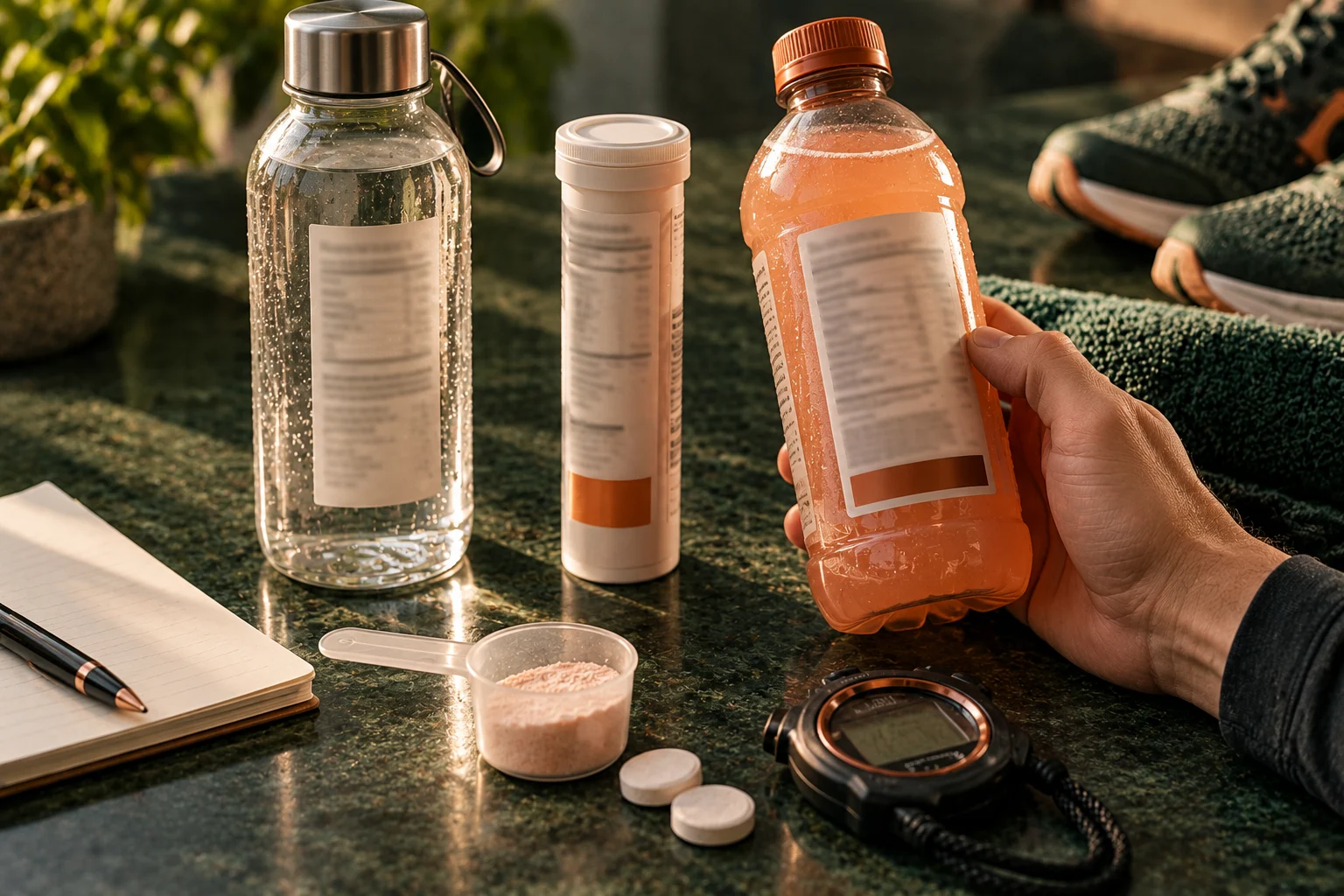
Sodium is often the largest number on a sports-drink label after carbohydrate. It can look precise while remaining hard to compare if one product lists 8 ounces and another lists the whole bottle.
Find the serving size first
FDA says the numbers on a Nutrition Facts panel apply to the stated serving size. If you consume two servings, the sodium figure doubles along with the rest of the listed nutrients.
Normalize before comparing
Convert both products to the same volume before declaring one higher or lower. USADA’s 2026 guide uses an 8-ounce reference in its sports-drink discussion, which makes the comparison unit visible.
Example only — not two real product labels: imagine drink A lists 120 mg sodium per 8 fl oz and drink B lists 200 mg per 16 fl oz. At the same 8 fl oz, A has 120 mg and B has 100 mg (200 ÷ 2). The larger number on B’s imaginary panel does not mean more sodium in an equal-sized pour. For a full 16 fl oz, the corresponding totals would be 240 mg for A and 200 mg for B.
A label reading is not a prescription
This guide shows how to compare what is printed. It does not tell a reader how much sodium they should consume or replace.
Keep the units beside the numbers
Write each figure as “milligrams per stated fluid ounces” before comparing. If the panel also lists servings per container, multiply only when you want the whole-container total. Keep that total separate from the normalized per-8-fl-oz comparison: they answer different questions.
The example above is deliberately fictional so it cannot be mistaken for a current product recommendation. Use the exact package in hand for real figures. A normalized number is a comparison tool, not an instruction to seek more or less sodium; personal requirements are outside what a label or this guide can establish.
Compare the same volume
Put sodium next to the amount of drink it describes before comparing products. A number per eight ounces and a number per full bottle are not comparable until their volumes are made visible.
- Serving size or full-container volume
- Sodium figure tied to that serving
- Whether multiple servings are consumed
- A consistent reference volume for any comparison
The first useful question is “per how much?” Once the volume is clear, the label becomes readable without turning into a prescription.
- FDA — Serving Size on the Nutrition Facts Label
- USADA — Fueling for Performance, 2026 Nutrition Guide