Home Bar · Thermal carafes
Choosing a Thermal Carafe for Hot Drinks
Check the permitted liquid before comparing volume, insulation claims or the finish on the table.
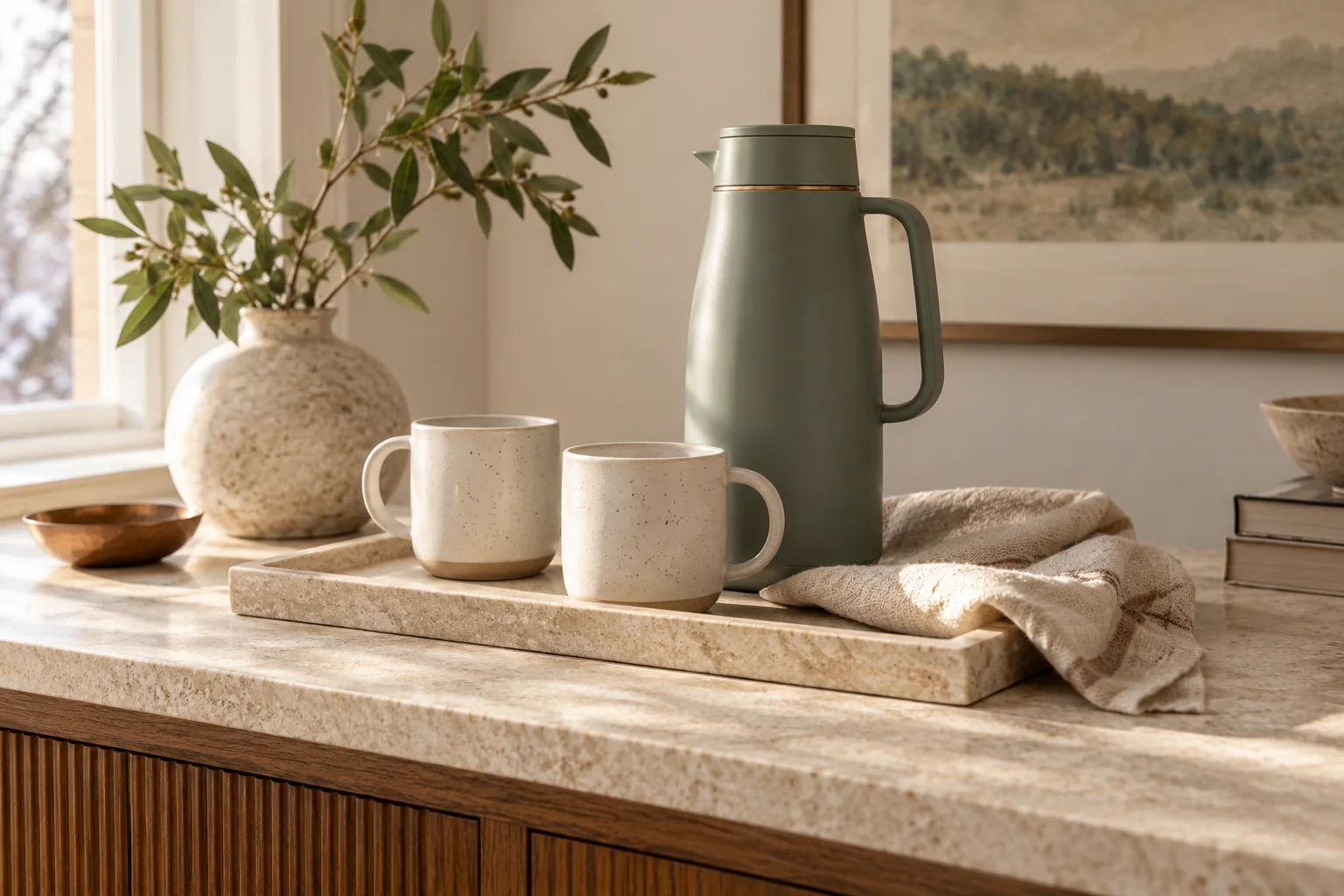
The exact model's instructions control the decision
- 01LiquidMatch
A mixed drink is not the same fill as plain water
- 02CareRead
Include stopper cleaning and reassembly
- 03CapacityPlan
Distinguish nominal volume from the permitted fill
A retention rating does not authorize excluded ingredients or a holding time
A thermal carafe can solve the wrong problem beautifully. It may keep water hot while being unsuitable for the apple juice, milk or pulp in the drink you actually intend to serve. Check the permitted contents before comparing finishes, sizes or impressive heat-retention numbers.
For a small gathering, there are really two possible purchases: a vessel to hold the finished drink, or a vessel to hold one permitted component. Those are not the same job. Buying for the second does not authorize the first, and changing the recipe to suit the carafe is not an automatic solution.
Read the exclusions before the capacity
Zojirushi's SH-HC10 and SH-HC15 are concrete examples. Its US product page identifies 1.0 and 1.5 liter stainless steel vacuum carafes. The manufacturer's English SH-HB/SH-HC manual is more useful for the first decision: it excludes carbonated drinks, dairy products, fruit juice, high-sodium liquids such as soup, and fruit pulp or tea leaves.
That rules out treating this model family as a general container for every warm mocktail. A drink containing juice does not become a compatible fill because it is strained. A dairy drink does not become approved because the outside of the carafe is stainless steel. The contents restriction comes before either capacity or appearance.
If you want a hot-water station rather than a premixed drink, the manual describes holding hot water and using tea bags or a small teapot for brewing. That is a different arrangement, not permission to put loose leaves into the stopper mechanism.
Turn the menu into a compatibility check
Write the drink's ingredients down the left side of a page. Beside each, record whether it enters the carafe or remains outside it. A hot-water station might keep the water inside and the tea bags and other ingredients beside the cups. A finished fruit drink puts juice inside too. Those two sketches lead to different compatibility decisions even when the same carafe appears on the table.
For example, a proposed warm fruit drink fails this model's fruit-juice restriction before you have any reason to calculate servings. There is no useful shopping calculation that makes an incompatible liquid suitable. Either find a vessel whose instructions allow the complete preparation or choose a different documented service plan.
This is why a carafe should not be bought as a generic holiday accessory. Naming the liquid it will hold may eliminate the purchase entirely. If an existing vessel is already suitable for the chosen method, matching it to the table is a design choice rather than an equipment requirement.
Calculate volume only after that check
Suppose your selected, permitted service needs six 150 ml pours. That is a hypothetical 900 ml allocation. Against a nominal 1,000 ml capacity, the subtraction leaves 100 ml on paper. It does not establish that the carafe may be filled to an arbitrary level or that every last milliliter will pour out.
The SH-HC manual requires space below the rim when filling. Follow its illustrated fill limit rather than translating our volume subtraction into a headspace measurement. Internal geometry is not supplied by a simple capacity label.
Write three different numbers on the plan: nominal vessel capacity, permitted fill, and liquid allocated to guests. They answer different questions. Do not add an extra guest merely because a rounded ounce label suggests there might be room.
A retention rating is not a party timeline
The US product page publishes heat-retention results with specified starting-water and room-temperature conditions. Those are manufacturer ratings for the stated setup, not a prediction for your room, repeated pouring or a mixed drink. They also are not a food-storage allowance.
For the practical buying decision, ask whether the permitted liquid and your service arrangement fit before treating the longest printed duration as the winner. Our comparison does not supply a holding time for a homemade preparation or validate a dairy or juice exception to the manual.
The lid matters as much as the liner. The manual warns that the carafe can leak if tilted even without operating the pour lever; it should remain upright during transport. A tabletop carafe is not automatically a sealed bottle you can lay in a bag.
Buy the cleaning routine as well as the carafe
The stopper comes apart for cleaning. The manual calls for washing and drying the relevant parts, excludes dishwasher use, and supplies reassembly diagrams. Read those before deciding that a one-touch pour will make the entire evening simpler.
A useful pre-purchase question is whether you can follow that routine after the gathering. Check the model number when identifying replacement parts; a similar-looking stopper from another carafe is not a documented substitute.
The sensible order is contents, care, service volume, then finish. Put the compatible vessel into your before-guests-arrive plan, with its preparation and cleaning steps visible. An elegant carafe earns its space by doing an allowed job, not by promising to contain every drink on the menu.
- Zojirushi US — SH-HC10/15 specifications
- Zojirushi — SH-HC model index and SH-HB/SH-HC English instruction manual