Home Bar · Measures
Jigger vs Measuring Spoon for Mocktail Measures
A US recipe can be measured with the tools you own, once the volume conversion is clear.
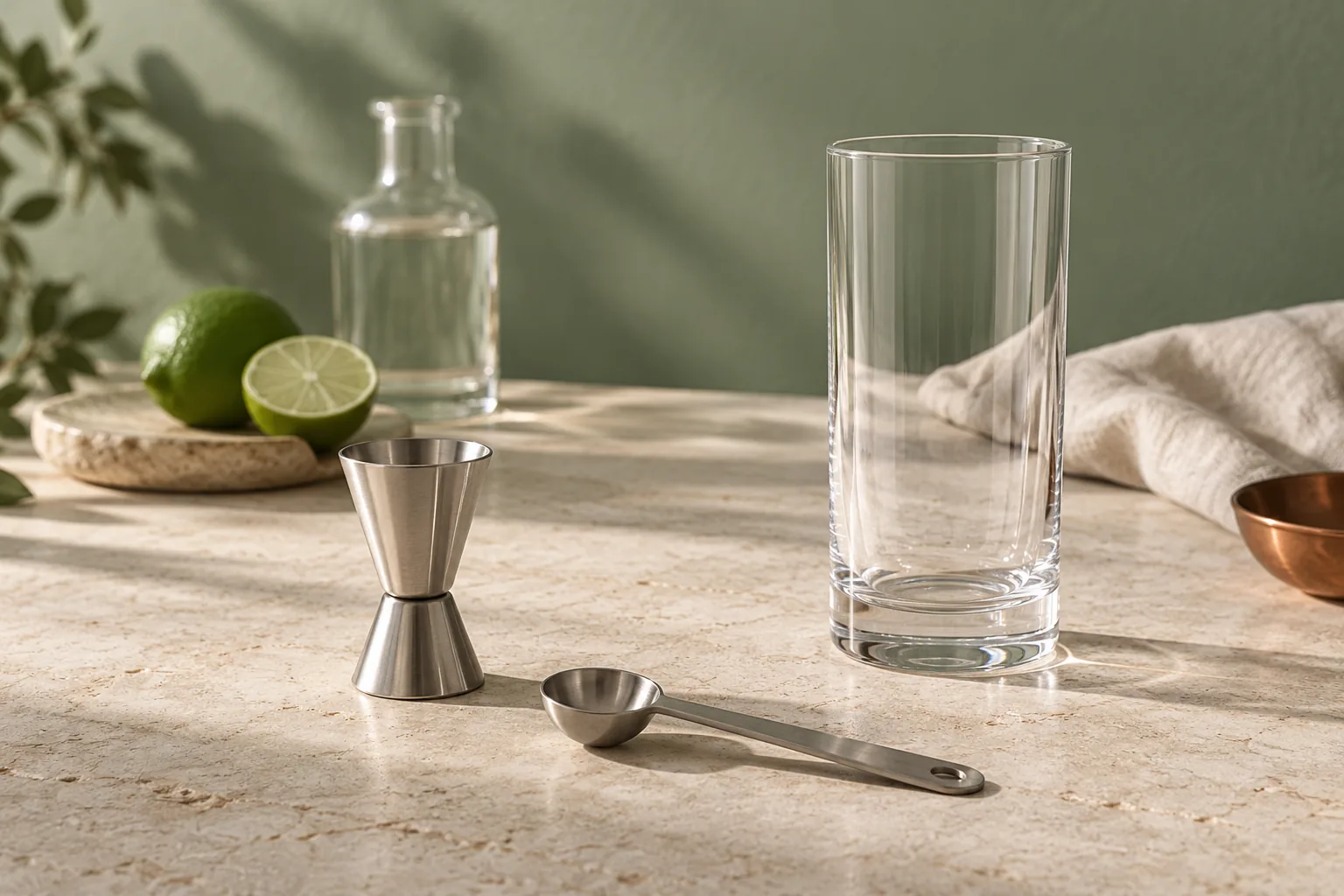
Your recipe says two fluid ounces. Your drawer has measuring spoons. That is not a reason to abandon the drink or buy a stainless-steel jigger before you know whether you will make it twice. It is a reason to convert the volume once, on paper, before there is ice in the glass.
The important word is measuring. A US measuring tablespoon has a defined capacity; the spoon you eat soup with does not. The National Institute of Standards and Technology lists one measuring tablespoon as exactly half a US fluid ounce and three measuring teaspoons as one tablespoon. These are units of volume. A fluid ounce is not an ounce of weight, and an ounce on a UK recipe is not automatically a US fluid ounce.
The small conversion card
| Recipe measure | US measuring spoons | A practical note |
|---|---|---|
| 1/4 fl oz | 1 1/2 tsp | Use a 1 tsp and a 1/2 tsp measure |
| 1/2 fl oz | 1 tbsp | A common syrup or citrus measure |
| 3/4 fl oz | 1 tbsp + 1 1/2 tsp | Useful for a sour's citrus measure |
| 1 fl oz | 2 tbsp | Check that both spoonfuls are level |
| 2 fl oz | 4 tbsp | A marked cup or jigger saves counting on repeat serves |
This table is for US measuring spoons, not an instruction to fill an eating spoon by eye. The fractions are exact relationships between the listed US measures; actual household tools can vary in how clearly they are marked or how neatly you fill them. If your spoon set has no half teaspoon and the recipe asks for a quarter fluid ounce, a small marked measuring cup or jigger is simpler than guessing what half a teaspoon looks like.
Let the recipe choose the tool
Ritual Zero Proof's published G&T uses 2 fl oz of its Gin Alternative and 4 fl oz of tonic water. Four tablespoons give the base quantity. Eight tablespoons would give the tonic quantity too, but that is a clumsy way to measure the larger liquid. A clearly marked liquid measuring cup can be more useful for the tonic, while a jigger makes the repeated 2 fl oz base pour quick. Neither changes the brand's 2-to-4 recipe.
For one glass, it is perfectly reasonable to use the spoons or measuring cup you already own. For six glasses, the same recipe calls for 12 fl oz of base and 24 fl oz of tonic. Measuring twenty-four tablespoons of base and forty-eight tablespoons of tonic would turn a simple service plan into an unnecessary counting exercise. At that point, use a larger marked vessel to portion the shopping quantity, then measure individual serves as the recipe requires. Do not pre-mix the tonic merely to save a few spoonfuls: the published G&T finishes it in the glass.
There is another reason to write the conversion down rather than memorizing a vague rule. Recipes may use 3/4 fl oz of juice, 1/2 fl oz of syrup and 2 fl oz of base in the same glass. If one measure is rounded casually while the others are exact, the resulting ratio is no longer the published one. We cannot tell you how that drink will taste; we can tell you which quantity the source actually asked for.
What to buy, if anything
Start with the recipes you expect to repeat. If they mostly use small, repeated ounce pours, a jigger with legible markings can save handling and counting. If they use one 1/2 fl oz addition and mostly larger mixers, your existing measuring spoons and cup may already cover the job. A tool is not an upgrade merely because it belongs in a bar photo.
The simplest check is to write each recipe's liquid quantities in one unit system, make sure your measure has the needed marks, and put it beside the ingredients before you start. Then the choice between jigger and spoon becomes what it should be: a question of convenience, not legitimacy.
- NIST — Handbook 44, Appendix C (2026)
- Ritual Zero Proof — Non-Alcoholic Gin and Tonic recipe