Hosting & Gifts · Thanksgiving
Non-Alcoholic Drinks for Thanksgiving Dinner
A welcome drink, ready options, and an optional toast, with one worked plan and no prediction of what guests will drink.
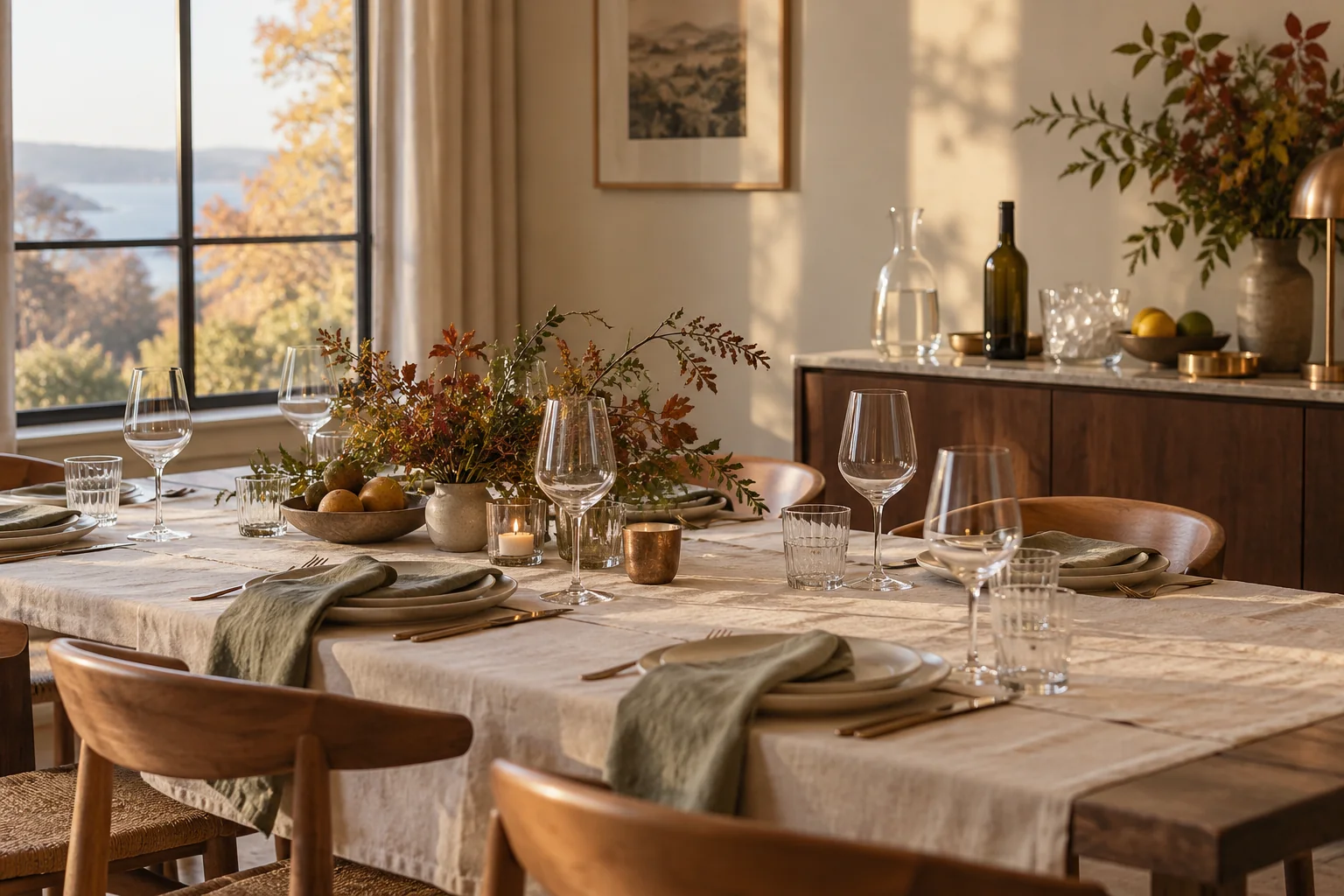
The refrigerator is already negotiating with a turkey, several serving dishes, and somebody's dessert. A Thanksgiving drinks plan should make that space easier to manage. Choose one drink to assemble when people arrive, keep a ready option for anyone who would rather open a container, and decide separately whether the table needs a toast. Water belongs alongside all three, not at the end of the menu as a consolation.
For the United States, Thanksgiving falls on November 26 in 2026. You do not need a special recipe for the date. What changes is the occasion: kitchen space is occupied, guests arrive at different times, and the person pouring may also be trying to serve dinner. A small menu made from documented drinks is more useful than a collection of new bottles with no service plan.
Give the welcome drink a limit
Here is an illustrative plan for eight adults, not a rule for how much eight people will drink. Suppose you want four made-to-order G&Ts and four sealed ready drinks available for the first round. Ask about preferences first; change the split if your guests want something else. The four ready units must actually be ready to drink, rather than small bottles of concentrate.
For the mixed route, Ritual's published G&T supplies a fixed measure. Four individual builds require 8 US fl oz of Gin Alternative and 16 fl oz of tonic, approximately 237 ml and 473 ml, plus ice and lime. Use those totals for shopping, then build each drink over ice when requested: base first, tonic after. The source gives a glass-by-glass method, not a made-ahead pitcher.
Put the required mixer on the list beside the base. A specialty bottle sitting on the counter is not four finished drinks. If you already own the base, measure what remains before buying another one. If nobody wants a mixed drink, skip this route rather than buying equipment to satisfy an imagined menu.
Treat the toast as a separate decision
The toast may involve some of the same people who had a welcome drink. Keep it on a second line so you can see whether you are planning another round or merely offering an alternative. In this example, assume six people want one 3 fl oz toast pour each. That is 18 fl oz, about 532 ml. The pour is our hosting choice, not a serving size prescribed by a winery.
Freixenet Mionetto USA lists its Alcohol Removed Sparkling White in a 750 ml format. One bottle nominally covers those six chosen pours before foam, spills, or top-ups. That does not establish that everyone wants this product, that it suits the meal, or that a second bottle is necessary. Keep any unopened reserve separate from the first-round count, and buy it only for a reason you can name.
For a different guest count, calculate the sparkling bottle requirement from your chosen pour. Change the number of people choosing the toast, rather than automatically counting every guest twice.
Freixenet's US page gives an alcohol range between 0 and 0.05%. Ritual's own product information states less than 0.5% ABV. Keep the exact statements available; do not describe the whole table as 0.0% because the menu is non-alcoholic. Guests can make their own choices without being asked to explain them.
Use a timeline instead of a crowded bar
Before shopping: confirm which routes people want, check the remaining liquids you own, and decide whether your glassware covers both the welcome drink and toast. A second glass for every guest is a storage choice, not an automatic requirement.
Before guests arrive: group the measured ingredients and tools for the G&T, put the ready options where they can be identified, and reserve space for the toast bottle. Follow each package's storage instructions. Check the actual containers against the shelf space you have, rather than planning around an empty refrigerator.
At service: build the mixed drinks as requested and open ready units as needed. Finish the toast decision when the people who want it are ready. The plan does not require pre-pouring six glasses while dinner is still in the oven.
Give the welcome and toast different jobs
An example clock makes the division clearer. Suppose arrivals begin at 5:30 p.m. and dinner is planned for 6:30 p.m. These are our scheduling assumptions, not instructions from either drink producer. Before 5:30, have the four ready units, water and G&T components available; keep the sparkling bottle for the later toast unopened. From 5:30, build the requested G&Ts one at a time. When dinner needs your attention, pause the mixed route and leave the ready option and water accessible. A short menu is still useful when the host sits down.
Choose the toast time with the table rather than promising a precise kitchen deadline. At that point, confirm who wants the six planned pours, find the appropriate glasses and open the bottle. A person who chose water on arrival may want a toast; someone who had a G&T may not. The two counts need not match.
Before shopping, make a physical cold-space check with the containers you intend to use. Can the four ready units, the tonic required for four builds, the toast bottle and your water arrangement fit alongside dinner? Can you reach the first-round drinks without moving the dessert every time? Leave the labeled bottles accessible, and keep ice in an appropriate frozen-storage space until needed. If the plan does not fit, reduce the simultaneous choices; a hypothetical second refrigerator is not part of the menu.
Afterward: identify opened products and follow their individual storage directions. Do not give a finished mixed drink the unopened base bottle's shelf life. Sealed extras and opened leftovers are different tasks.
Make the menu easy to change
The eight-person example makes eight first-round options available and six optional toast pours. It does not say each person should have two drinks. Keep plain water accessible, avoid promising a universal food pairing, and let a guest decline any option without making it the subject of the meal.
If a bottle is unavailable, retain the service structure and choose another documented route. Do not replace a recipe's base silently or call juice with soda the same G&T. For this occasion, the useful luxury is a host who can sit down: one working mixed option, a clear ready option, and a toast only if the table wants it.
- Ritual Zero Proof US — Gin & Tonic recipe and Gin Alternative
- Freixenet Mionetto USA — Alcohol Removed Sparkling White
- NIST — Handbook 44, Appendix C
- US Office of Personnel Management — Federal Holidays