Home Bar · Straining
Cocktail Strainers for Mocktails
Keep the mixing ice or fruit pieces behind with a tool that belongs to your recipe and vessel.
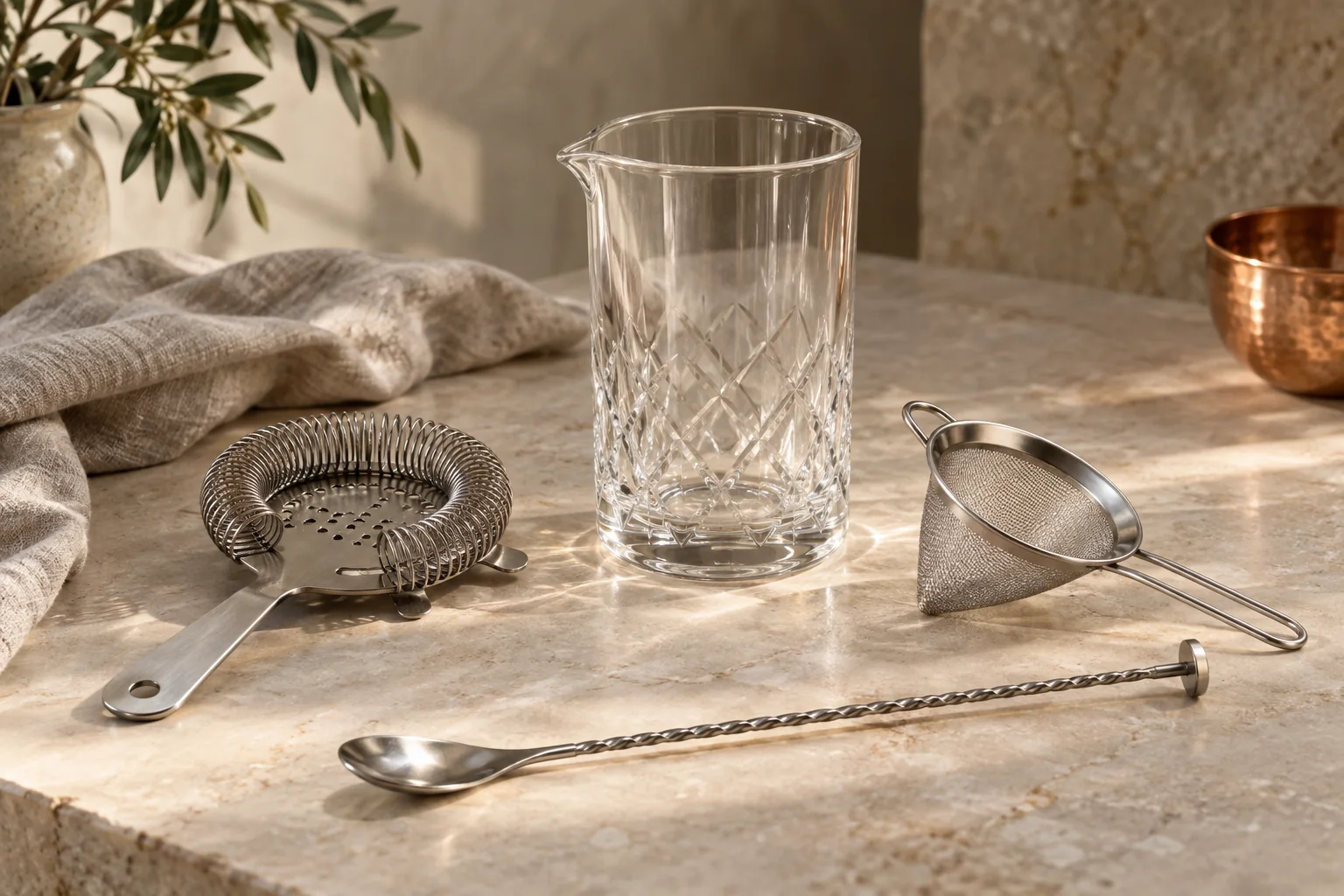
These are method choices, not a ranking of tested tools
- 01Mixing iceRetain
Check the strainer against the vessel opening
- 02Fine filtrationSieve
Follow the recipe when it names a fine sieve
- 03Built drinkSkip
No straining step means no tool to buy for that glass
A product description does not establish fit, grip or filtration speed in your setup
A strainer earns its place when something needs to stay behind. That might be the ice in a mixing glass, or fruit pieces after a recipe asks you to crush them. It does not follow that every mocktail needs three strainers—or that the strainer supplied with a shaker does every job.
Start with the container you will pour from and the instruction you are following. A drink built directly in its serving glass may need no straining at all. A stirred drink poured off its mixing ice needs a way to retain that ice. A recipe asking for a fine sieve adds a different requirement. These are purchase decisions, not a hierarchy in which the most equipment makes the best drink.
Three shapes, three questions
The OXO Steel Cocktail Strainer is a spring-style tool: its product description explains that liquid passes through the spring. Cocktail Kingdom's Premium Julep Strainer is a perforated spoon-like design that the maker says fits standard and large mixing glasses. The same company's COCO is a mesh cone, marketed for filtering ice chips and pulp. Those descriptions establish their intended jobs, not a guarantee that any one will fit a vessel you already own.
| Tool type | Question it helps answer | Check before buying |
|---|---|---|
| Spring or Hawthorne style | How will I hold back the mixing ice as I pour | Opening, rim and how the tool is supported |
| Julep style | Is this the straining arrangement intended for my mixing glass | Actual vessel dimensions, not just the word standard |
| Mesh sieve | Does the recipe call for finer filtration after fruit or another preparation | Basket size, how it sits above the receiving glass and care instructions |
Do not read that last row as a reason to strain every drink twice. A second operation should come from the method, not from having bought another accessory. Nor does a mesh tool have to sit inside the mixing vessel: its relationship with the receiving glass matters too.
OXO's separate Steel Fine Mesh Cocktail Strainer, SKU 3112000, is another conical mesh example. The maker lists stainless steel and dishwasher suitability. It is not the spring-style OXO tool or the Cocktail Kingdom COCO above, and its description does not settle support over your particular receiving glass. Keep a suitable kitchen sieve if it already covers the recipe's request.
Let one real recipe settle the question
Maple from Canada's New Year's Day Maple Mocktail crushes frozen cranberries with maple syrup, shakes the measured ingredients with ice, then calls for a fine sieve before the sparkling ingredient is added. That is a specific reason to have fine filtration available. A general instruction to pour off mixing ice would not tell the whole story of that recipe.
This is an equipment example, not a recommendation to improvise its ingredients. Its gin and sparkling beverage also need their own product checks. The useful lesson here is the verb: the source expressly asks for a fine sieve. Buying a spring strainer because it looks more like bar equipment does not erase that instruction.
For your next recipe, underline the words after shaking or stirring. If the source names a tool, check that requirement. If it merely says to strain and you cannot tell what it intends to retain, do not turn the photograph into a detailed filtration specification. The missing instruction belongs on the question list before the shopping list.
Check the fit before ordering
Measure the opening of the vessel you own. Compare it with the tool's published dimensions, including the part that needs to rest on the rim. Look for an explicit compatibility statement where the manufacturer supplies one. A wide mixing glass, a narrow shaker tin and the opening of a domestic jar are not automatically the same fit.
A dimension comparison can rule out an obvious mismatch. It cannot establish a comfortable grip, a drip-free pour or how quickly a pulpy mixture passes through a mesh. Treat those as untested questions, not as benefits proved by a product page. If the fit cannot be established, a return policy or the option to keep your existing setup may matter more than the finish.
Set out the empty equipment before the occasion: mixing vessel, retaining tool if required, sieve if required, and receiving glass. Each piece needs a supported position and a clear pouring path. If that arrangement needs an extra hand or a precariously balanced sieve, solve the fit before guests arrive. A loose household lid is not a universal strainer.
Buy a finish you can care for
The exact OXO steel model reviewed here is marked dishwasher-safe. That is not an instruction for every bar tool with a metallic appearance. Cocktail Kingdom's gold-plated COCO listing, for example, explicitly rules out dishwasher use. Stainless steel and a plated finish should not share a care instruction by assumption.
Check the care page for the finish you will actually order, and consider whether a spring or mesh has accessible areas you are willing to clean as instructed. The attractive copper-colored version may be the wrong purchase if you want an item you can put through your usual dishwasher cycle. There is no need to claim one finish pours better to make that choice useful.
The smallest useful purchase
If your menu consists of built drinks, keep the money and shelf space. If a source requires straining off ice, solve the vessel-and-tool fit first. Add a fine sieve only when the method gives it a job, rather than buying an entire set against a future menu you have not chosen.
The next question is whether your recipes need a shaker at all. Settle that before ordering a bundle. One suitable straining arrangement that belongs to a real drink is a more coherent home bar than three polished tools waiting for a reason to exist.
- OXO — Steel Cocktail Strainer
- OXO — Steel Fine Mesh Cocktail Strainer 3112000
- Cocktail Kingdom — Premium Julep and COCO strainers, exact finishes
- Maple from Canada — New Year's Day Maple Mocktail